.png)
India's first & foremost horse racing portal
 Register Now


THE INDIAN DERBY 1970
By Anil Mukhi | 27 Aug 2015 |
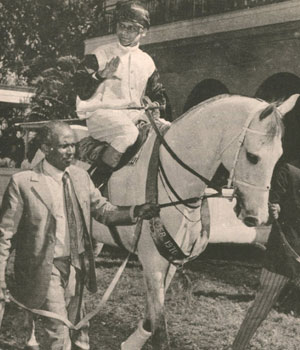
Thunder Storm being paraded in the paddock at Mahalakshmi Racecourse (Pandu Khade up). Photo courtesy Jehangir Rustomjee
For decades, there has been controversy over the participation of geldings in Classic races. Those who aver that the object of racing is the improvement of the breed will naturally question how geldings can be permitted in such events, since they cannot reproduce. Further, if intrinsic ability, unaffected by drugs or artificial aids is the criterion of excellence -- as it must be -- then geldings have no role. After all in nature, there are no geldings!
Even today in most major racing countries, geldings remain debarred from running the Classics because it is considered pointless to allow the most prestigious prizes in racing, along with some of the highest levels of stake money in the racing calendar, to fall to animals which would have no concern with the progress of the Thoroughbred at stud.
Thus when, in the mid-sixties, the turf authorities in India opened up the Blue Riband of the Indian Turf and the other colts classics to all Indian-breds foaled in a particular crop (which meant that geldings were permitted to race in them), there was a predictable hue and cry.
In fairness, one has to look at the conditions prevailing on the Indian Turf at the time. There were very few horses to go around – the crop of 1966 contained just 296 individuals which had to be divided between Bombay, Calcutta and Madras, the three major racing centres of the era. Moreover, foreign horses – of which there were very few in any case – were not permitted to take part in the Classics. Finally, there was almost total neglect of Indian Classic winners at stud so it was not as if they would be much missed – or so the reasoning went.
Presumably all these considerations weighed on the mind of the turf administrators of the time. It was felt that not much would be lost to the breed by the controversial move but that racing itself would benefit. It was argued that the ultimate objective was, after all, to determine which was the best horse. Interestingly, the policy was reversed around 1976 (no more geldings) and then reintroduced a few years later!
With the benefit of hindsight, one has to conclude that not much has changed since then. Looking only at the period after 1966, it's safe to say that despite the perfectly satisfactory results at stud – relative to opportunity – for the likes of Sir Bruce, Royal Tern, Exhilaration, Elusive Pimpernel and Indictment, the majority of promising Classic-calibre colts in India continue to be gelded. Thus a self-fulfilling prophecy -- that Indian-bred stallions are no good -- gets perpetuated. Could the fact that geldings tend to be less temperamental, and thus more reliable for gambling purposes, have anything to do with it??!!
Anyway, to return to our main story – in early 1968, a grey colt bred by Maharaja Madhavrao Scindia of Gwalior at his Manjri Stud on the outskirts of Poona was retained by him for racing. The two-year-old entered the Mahalakshmi yard of the Gwalior trainer, Major V.M. Lad, a fine gentleman and a patient schooler.
The colt was one of just three foals born in 1966 sired by the Manjri resident Gul Mohar*, a high-class English-bred who was imported to India as a yearling to race for "George", as Maharaja Jiwajirao Scindia of Gwalior was popularly known. The son of noted sprinter Abernant won 11 races in his adopted land, including the Turf Club Cup, and ran second in the Eclipse Stakes of India in 1961. Incidentally, his fourth dam was none other than the famed Pretty Polly.
Dam of the new colt was an imported daughter of Pardal named Canary*, whose first offspring, Brijendra, was already in training with Major Lad. Described as a "neat, strong" sort, Canary* placed at both her starts in England under the tutelage of Maj. Jack Clayton but was unplaced in India after suffering an injury. Her grandam, Sixtine, was an own-sister to Comte Evremond de Saint-Alary's Samos, heroine of the Prix de l'Arc de Triomphe of 1935, so there was plenty of stamina in the bottom half of the pedigree.
Major Lad broke in the son of Gul Mohar* but found him extremely difficult to train. He did manage to get Thunder Storm, as he was named, to make a couple of starts in March 1969, but the colt showed nothing significant by way of ability, probably because he was immature and the distances were too sharp.
Later that year, the Gwalior hope began to display a mulish attitude at the starting gates which instilled fear in his handler that his obstreperous ward would prove to be a total waste of time. These considerations no doubt contributed to his being separated from his masculinity by a surgical procedure, with connections being secure in the fact that gelding him would not adversely affect his eligibility for the Classics – for which he had been entered.
Although Major Lad was well aware of the grey's potential, in a moment of weakness he offered the gelding as a maiden three-year-old for sale. Fellow Western India-based schooler, Dara Pandole, who enjoyed an old-fashioned gamble, decided the modest price, said to have been in the region of Rs.25,000, was worthy of a flutter. He put together a group of friends, which included M.H. Khajotia, H.H. Vaziralli and Sorab Karaka, and persuaded them to take a chance.
Of course, at the time none dared hope that Thunder Storm, by now handicapped in the lowest class, would achieve greatness. A few lucrative handicap victories were the best that might have been foreseen.
On the opening day of the Bombay Meeting of 1969-70, Thunder Storm made his third career start – and the first for his new connections – in a Class VB race, with stable confidant Jalal Khan up. The gelding ran unplaced, but only just off the board in fifth. The positives that trainer Pandole could take away from this effort were that (a) his weeks of schooling his ward to be more tractable at the gate had paid off, and (b) the horse had become fitter with the run after a long period on the shelf.
Three weeks later Thunder Storm won a Class VB sprint cheekily as the well-backed evens favourite, then stretched out to 1800 m. to notch up another victory in the higher class with visiting rider, Glaswegian John Murrin ("Jock") Wilson up. Perhaps lucky to be retained in Class VA, he completed a hat trick in January 1970, triumphing over the metric mile by a margin of 6 lengths. This facile win saw him immediately promoted to Class IV. Within the stable they now knew they had a Derby contender on their hands and a sizeable stable commission was wagered on him at long odds for the "Blue Riband".
Perhaps the ease of this success persuaded Dara Pandole to bring Thunder Storm out again just a week later, that too over 2400 m., but in an unsatisfactorily-run race in which possibly Wilson gave him too much to do, the gelding suffered a rare setback by being outpointed by Gallant Fox, a horse trained by Rashid Byramji for his patrons, the brothers F.A. & K.A. Irani, and his father Rustomji Byramji. The winner was steered by the stylish Joe Mercer, then retained by the stable: he was later to partner the great Brigadier Gerard in all his races.
Opinion was divided as to whether Thunder Storm had been beaten on merit, or whether he had been a victim of misjudgment – an error that might also have had the effect of helping to obscure his chance in the Derby.
While these so-called "lesser lights" were climbing the handicap ladder, the leading four-year-old colt in the country was enjoying a solitary romp in the feature races of that Bombay Meeting, having annexed his first four starts, which included the "Morvi", the Indian 2000 Guineas and the "Ruia". This was Loyal Prince, a chestnut colt trained by veteran A.L.J. Talib, owned by his wife, her nieces and Mr. R.N. Kanga. Loyal Prince was a son of their own Indian Triple Crown winner, Loyal Manzar, and had been ridden to his most recent victories by Ernie Johnson, who was at the time the reigning Epsom Derby champion, having taken home what is arguably world racing's most prestigious prize with Blakeney in June 1969.
A minor blip was recorded when Loyal Prince, faced with the task of conceding 7 kgs. to Ruia Cup runner-up Snowden in a Class 2 handicap, went under by three-parts of a length, but he faced no danger from that foe at level weights. With that sort of overall record, it came as no surprise that on Derby day Loyal Prince, with Johnson up, was installed as an odds-on favourite at 10/9 on. Next in demand was the afore-mentioned Snowden, owned by Mr. N.E.D. Pandole and his trainer D.C. Jarvis and ridden by Joe Mercer, at 6 to 1. Thunder Storm followed, along with his recent conqueror Gallant Fox, at 9 to 1 and 10 to 1 respectively. Despite the presence in the saddle of the top class Geoff Lewis, the Aziz Mahmoud-trained Look Out was scarcely supported at twelves.
The race was one of the most exciting of all the many Indian Derbies this writer has witnessed. After Billionaire led down the backstretch before calling it a day, a group of horses drew clear of the bunch midway up the long Mahalakshmi straight. Much to the satisfaction of the public, Loyal Prince was amongst them. Also right there, and quite visible due to his striking grey coat, was Thunder Storm. The leading pair were accompanied by another gelding, M/s. Surjit Chhabda & Suresh Mahindra's experienced Look Out, making his 15th lifetime start.
It was anybody's race 200 metres from home, but Jock Wilson riding one of his characteristic strong finishes was able to get the gallant Thunder Storm home by three-parts of a length, with a head between Look Out and Loyal Prince in 2nd and 3rd place, respectively.
This was really a crowning triumph for trainer Pandole, who had taken Thunder Storm from being a horse who could not win in Class VB to a winner of the most coveted race in the country in a mere 76 days. Look Out was another surprise packet here because he seemed "well held" on form. As regards the beaten favourite, Loyal Prince, it was said that he had missed the finishing touches of "The Master" for his Derby preparations owing to his trainer A.L.J. Talib having being stricken with a grievous illness soon after the colt's Indian 2000 Guineas victory. In fact, sadly Talib breathed his last shortly before the Indian Derby and his ward ran in "All Black".
Thunder Storm was the first gelding to win the Indian Derby, although Bakhtawar, Gay Time and Con Amore had all "placed" in previous years. A massive gamble had been landed, but bookmakers were not too unhappy, having raked in the moolah on the beaten favourite! Following Talib's death, Loyal Prince moved to the barn of Dady Adenwalla and stormed back to form by pegging back Thunder Storm at their next meeting, which came in the Indian Turf Invitation Cup run that year at Mahalakshmi in March. However, the Derby hero was not done for the season as yet – he made one more successful effort in a Class 1 handicap, accounting for the evergreen Bakhtawar.
In September 1970, at Pune, Thunder Storm took the four-runner Indian St. Leger from Look Out, with Loyal Prince an absentee. Geldings go on running and the grey remained in training notching up several successes before he retired in 1973 as the then highest-stakes-earner on the Indian Turf. For a club that rarely attempts people-friendly measures, the RWITC Ltd. displayed commendable initiative when arranging for Thunder Storm, his racing days now history, to be paraded before the packed grandstands on Indian Derby day 1973.
It is reported that he was donated to the Hyderabad Race Club and led the paddock parade before each race at that centre until he died about five years later.
Acknowledgement: Special thanks to Mr. D.P. Kothavala for his valuable inputs
News Letter
Contact
Email: info@indiarace.com

- HOME
- STUD FARMS
- ARCHIVES
- GLOSSARY
- CLASSIFIEDS
- EX-NAME SEARCH
- DAM
- SIRE
- ROLL OF HONOURS
- FEEDBACK
- HORSE TALK


