.png)
India's first & foremost horse racing portal
 Register Now


INDIAN DERBY SIXTY YEARS AGO
By Major Srinivas Nargolkar (Retd.) | 02 Jan 2020 |
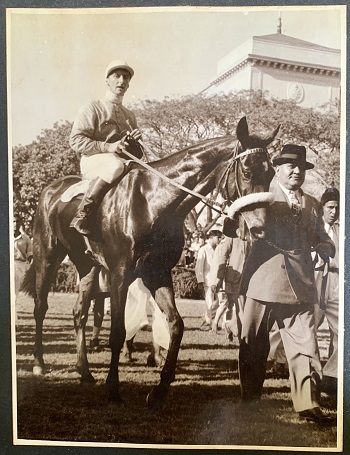
H.H. Maharaj Himmat Singhji of Idar leading his first Indian Derby winner Jeanne d'Arc who, like Rose de Bahama, was ridden by Bill Rickaby
The year 1960 started off well for the sports loving city of Bombay. On the New Year's day India, fresh from its first ever victory over Australia at Kanpur, started the Third Test at Brabourne Stadium with the series level at 1-1. It ended in a draw but the hometown boy Nari Contractor -- later a keen racegoer -- scored a century much to the delight of the locals. On the last day of that month there was the Indian Derby at Mahalakshmi to whet the appetite of the racing cognoscenti.
It was truly "Indian" because the field of a dozen runners included challengers from the other two winter centres, Madras and Calcutta. From the South came Random Harvest -- winner of the South India Derby -- and Pride of Andhra. Calcutta was represented by Ghazi who had won the Calcutta Derby on the track but lost it in the Stewards' Room following a successful objection by Rising Bell. Ghazi was accompanied by Coral Bay who had placed third behind him and Rising Bell. The home contingent had numbers in its favour but its hopes rested on a filly called Rose de Bahama owned by H.H. The Maharaja Himmat Singhji of Idar. A filly had not won the Indian Derby since 1948. If that was a disconcerting fact, the silver lining was that Jeanne d'Arc, the last filly to win the Indian Derby, was also owned by Idar.
To be sure, Rose de Bahama was worthy enough of carrying the local flag. Trained by Narayan Singh, she had five wins from eight starts including victories in the Indian 2000 Guineas and Indian Oaks. She was fourth -- an 'educational' run -- on her debut the previous January and second to the colt Royal Manzar in the Moss Cup. Royal Manzar, owned by Mrs. A.L.J. Talib, won twice more that Bombay season to stamp himself as the best of his age. Rose de Bahama won her remaining two races without a fuss at Mahalakshmi that year and looked a potential Classic contender. Neither Royal Manzar nor Rose de Bahama raced during the monsoon at Poona where the filly Lady Josephine won twice to emerge as a promising sort. Lady Josephine, however, migrated to Guindy before the winter seasons started.
Rose de Bahama contested the Bombay City Cup after a seven month lay-off. It was an unusual race to make her re-appearance for it was run over 1800 m. and filly had never raced beyond 1200 m. It had a field of 18 runners and Rose De Bahama was giving weight to all of them bar two. Ridden by Dixon, Rose de Bahama scored a stylish victory, being handy till the bend and then taking charge early in the straight. That made her a 5/4 favourite for the Indian 1000 Guineas in mid-December. Dixon was once again in the saddle and he attempted to replicate her previous start tactics, keeping her behind Pondicherry. Pondicherry was setting the pace for stable-mate Roman Rose and led at a strong pace. Having done her job perfectly, she was a spent force and wandered all over the course, interfering badly with Rose de Bahama. In the meantime, Chavan had shot Roman Rose into the lead and the Kashmir filly won easily from Nilanjana with the favourite a poor third. The Idar camp was adamant that but for being impeded, Rose de Bahama would have won the race.
Like Rose de Bahama, Royal Manzar had rested during the Poona Season. His seasonal debut at Bombay was even more impressive as he slammed Pondicherry and Rais-ud-Daula by a distance in the Maharaja of Morvi Trophy. Unfortunately, Royal Manzar collapsed and died on the training track after his winding up spurt for the Indian 2000 Guineas, leaving the race wide open. The first three finishers in the Indian 1000 Guineas grabbed the chance to take on seven colts. The local colts were decidedly an inferior lot and that had prompted the southern challenger, Baba Khan's Mohsin The Second, to make the journey to Bombay. The absence of Royal Manzar meant that his jockey Stan Smith was without a ride and Idar made haste to secure his services for Rose de Bahama. Mohsin The Second was an odds-on favourite with Roman Rose also receiving plenty of support. The favourite took charge coming into the straight and led up to the distance where Roman Rose flattered momentarily. Stan Smith had dropped Rose de Bahama completely out of the race till the bend. He had then made steady progress and while Mohsin The Second and Roman Rose were engaged in their brief tussle, he had brought the Idar filly into contention. The momentum was with Rose de Bahama and she pegged back Roman Rose by a little over a length.

The Talib stable claimed Stan Smith's services for Seven Stars in the Indian Oaks for which Baba Khan brought back Raja of Bobbili's filly Lady Josephine who had won the South India 1000 Guineas at Guindy. Idar engaged Pandu Khade, who had won on Rose de Bahama in her first year, for the Indian Oaks. Rose de Bahama started at 13/10 but 6/4 was available if you looked around the ring. Smith took the early lead on Seven Stars but Lady Josephine grabbed the initiative passing the mile marker and led by lengths till the top of the straight. Khade, trusting Stan Smith's tactics, had switched off Rose de Bahama early in the race. He brought her with a steady run from the back, went past Roman Rose and scored by easy four lengths from the late finishing Nilanjana.
The Indian Derby was a week later and with Stan Smith and Pandu Khade already committed to other runners, Idar was without a jockey. He summoned Bill Rickaby , who had been aboard his Jeanne d'Arc twelve years previously, from Calcutta. Kashmir made his customary Derby-eve purchase, acquiring the filly Nilanjana from the Gandhis and running her as Frontier Light. Rose de Bahama had the maximum support in the ring and started at 7/4 but Random Harvest, too, had his loyal fans. Rickaby had been instructed to bring Rose de Bahama with a late run. Pride of Andhra was kicked by another runner before the tapes went up and the race was on. After the lead had chopped and changed early on, Kashmir's Erin Way assumed charge at 1400 m. and led right up to the straight where Rais-us-Daula (Khade) and Random Harvest (Jagdish) challenged him. There was a little scrimmage between them. That made Razzmatazz and Frontier Light go a bit wider. Pride of Andhra and Rose de Bahama were beginning to improve from the rear of the field. Cracknell brought Pride of Andhra through the centre and opposite the First Enclosure he had the lead. An upset looked to be on the cards and the crowd was stunned. But Rickaby, a man who had seen action in North Africa during the World War II, was not a man daunted easily. He had a filly under him with plenty in the tank and she responded magnificently to his urgings. She drew level with Pride of Andhra on the very wide outside and nailed him right on the post. To win the Indian Derby by a short-head with two fillies, both favourites, both sporting the Idar silks was surely an incredible coincidence ! (Footnote - Khade was later suspended for careless riding on Rais-ud-Daula but the placings remained unaltered).
Rose de Bahama had much to look forward to her next race, the Indian St. Leger. She was the first filly with a chance to win the Indian Triple Crown. She had already placed in the first four Indian Classics and could emulate Her Majesty and Maharaj Koomari who had placed in all five before her. The first four Classics had all been won by daughters of Flower Dust and a possibility of them making it a clean sweep existed. None of these feats came to pass. The problem was in finding her a jockey for Rickaby had returned to England. J. McGaffin came over from Calcutta to ride her which meant that she had a different jockey in each of the five Classics. McGaffin had been briefed to ride a waiting race but for some inexplicable reason chose to be close to the early pace, took charge soon after entering the straight and was well beaten, failing to even make the board. Khade, back from his brief suspension, won the race on Rais-ud Daula for the Maharaja of Gwalior. A feature of that year's Indian Classics was that all winners had names beginning with the letter 'R' and all were born in March.
South African horse sickness broke out in Bombay soon after and racing was disrupted. As in the previous year, Rose de Bahama did not race at Poona. At the start of the 1960-61 winter season, the Maharaja of Idar passed away. It was his wish that his horses meet their intended engagements and so Rose de Bahama, now owned by his younger son Maharaj Amar Singhji, raced thrice at Mahalakshmi without achieving anything noteworthy. She was then sent to Qutab Stud but remained barren to her visit to Asopo. She was put back in training, raced for two more years, winning the Willingdon Cup at Poona and the Brabourne Cup at Bombay. Sent back to stud, she again remained barren, this time to Loyal Manzar. Her further returns were not submitted.
A compact, beautifully balanced filly, she had been purchased privately by the Maharaja of Idar from the Maharaja of Gwalior. Over four years of racing, she had raced 27 times, winning eight races, being on board on 22 occasions and earning almost Rs. 2 lakhs in stakes. Her treble of Indian 2000 Guineas, Indian Oaks and Indian Derby remained unique till Jacqueline matched it 50 years later.
INDIAN DERBY 1960
Bombay, Sunday, 31 January 1960
A Gold Trophy value of Rs. 3,000. Sweepstakes of Rs, 800 with Rs. 55,000 added from the Fund. Total stakes Rs. 97,400. Winner, the Trophy and Rs. 62,457.75; second, Rs. 18,506; third, Rs.11,566.25. Rs.4,870 to the Breeder of the winner. For Indian colts and fillies four years old only (foaled in 1956). Colts, 9 st, fillies 8 st. 9 lbs. One and a half miles.
1. ROSE DE BAHAMA (WA Rickaby) (7/4, favourite)
(b f Flower Dust* - Bahama* by Bokbul)
H.H. The Maharaja of Idar
2. Pride of Andhra (EJ Cracknell) (20/1)
(ch rig Redbay* - Pre Catelan by Bouldnor*)
The Zamindar of Chikkavaram
3. Rais-ud-Daula (P Khade) (10/1)
(b c Hyder Ali* - Merrybargo* by Embargo)
H.H. The Maharaja Scindia of Gwalior
4. Random Harvest (M Jagdish) (2/1)
(b c Bellrue* - Aroma by Solar Day*)
M/s. Baba Khan & SM Ramakrishna Rao
Also ran: Frontier Light (MJ Rajoo, 12/1), Razzmatazz (P Boothman, 15/1), Erin Way (S Chavan, 10/1), Ghazi (M Cracknell, 8/1), Coral Bay (S. Smith, 12/1), August Approval (WJ Stevens, 10/1), Bhaijan (Fakruddin, 40/1) and Wild Flower (MJ Hayes, 30/1).
Winner trained by Narayan Singh
Verdict: Shd, 1 1/2, 1 Time: 2.45 Field: 12 runners
Tote: Rs. 25 for win and Rs. 12, Rs. 200 and Rs. 21 for places. Forecast: Rs. 1080.50
ROSE DE BAHAMA (Seventh Foal), b f, 9 March 1956
Bred by H.H. The Maharaja Scindia of Gwalior
Bred at Manjri Stud, Pune (Maharashtra)
| Pink Flower | Oleander Plymstock |
||
| Flower Dust* | |||
| Brazen Molly | Horus Molly Adare |
||
| ROSE DE BAHAMA | |||
| Bokbul | Blandford Buanderie |
||
| Bahama* | |||
| Ziraleet* | Knight of the Garter Ayn Hali |
H.H. Maharaja Himmat Singhji of Idar raced enthusiastically with much smaller strings than what the Maharajas o Baroda, Kashmir and Gwalior fielded. Yet, when he passed away on 24 November 1960, he had won six Indian Classics. Kashmir, of course, was way out in front but Idar held his own with Baroda and Gwalior. His grandson, Rajendra Singh of Idar established the Pratap Stud Farm in the early 1970s and raced prominently for a while. Pratap Stud is still holding on and one does see the Idar colours on the track even now though very occasionally. A little known fact is that the Idar Cup, established in 1932 by Maharaja Himmat Singhji, is the oldest race in the country exclusively for Indian-breds, that is still run though it has undergone changes of terms and venue.
William "Bill" Anthony Rickaby -- called "Buster" by his close friends -- was born in a racing family in 1917. The legendary Lester Piggott was his first cousin. One of the most popular jockeys of his day, he was known for his integrity, sportsmanship and modesty. As a jockey he modelled himself on "Brownie" Carslake and in a career spanning 37 years rode 1324 winners in eight countries. For a jockey of his calibre, he rode winners of only three Classics in England -- Sweet Solera (One Thousand Guineas and Oaks) and Privy Councillor (Two Thousand Guineas). He tasted much more success at higher levels in India which he first visited in 1937. That year itself, he won the Viceroy's Cup on Mr. E. Esmond's Fastnet. Fastnet was beaten only a neck and a head by Why and Finalist in the Eclipse Stakes of India a couple of months later at Bombay. He won the Viceroy's Cup again on Selector and the same race, renamed Queen Elizabeth II Cup, on Contralto and Ridicular. His six wins in the Indian Classics came atop Jeanne d'Arc (Indian 1000 Guineas and Indian Derby), Royal Crusader (Indian 2000 Guineas), Rose de Bahama (Indian Derby) -- all for Idar -- and Prince of Ramgarh (Indian 2000 Guineas and Indian St. Leger) for Rao Saheb D.K. Parker. Had Prince of Ramgarh not been beaten by a neck in the Indian Derby by Balam, Rickaby would have ridden the first Indian Triple Crown winner. After retiring from riding, Rickaby took up a job as a Stipendary Steward in Hong Kong where he suffered a horrendous car crash and was fortunate to survive. Back in Newmarket, he recovered slowly. He died in 1987 at the age of 70. His autobiography First To Finish, published in 1969, has several interesting vignettes of his Indian experiences.
Narayan Singh, who saddled Rose de Bahama, was an average jockey who started his career riding for M.C. Patel. Meeting little success, he drifted to riding at Rajkot and Delhi and returned to Bombay in the mid-1950s. He took over as Idar's private trainer in April 1956 and the first runner that he saddled, His Lordship, won by four lengths under Khade as a raging hot favourite. The 1959 Indian Derby winner Fair Wood had started his career in Narayan Singh's care as Vandyke. Idar later sold Vandyke. With Idar's sons not interested in racing, Narayan Singh handed in his license. When Idar's grandson took up to breeding, Narayan Singh helped him to set up the Pratap Stud. Once it was up and running, Narayan Singh moved to Bangalore to commence his second innings as a trainer. For Sardar Darshan Singh Ghumman, he sent out Classic winners Sarb-Kla, Ekta and Anekta. After Sardar Ghumman started training his own horses, Narayan Singh trained for the Saravanam family for a while. He moved to Calcutta in the early 1990s. The last winner that he saddled was Cannon Ball during the Calcutta Monsoon season of 1995. He passed away at Mysore in 2006 at the age of 79.
PAST THE POST
The friendship that existed between Maharaja Sir Hari Singhji of Jammu and Kashmir and the retired American diplomat R.B. Strassburger -- and the impact it had on Indian racing -- has never received much mention or its deserved due. Strassburger was overshadowed by Boussac and Dupre but his experiments in bringing together strains of the Chelandry family with Blandford as well as the Teddy male lines and trying out various combinations of Fair Trial, Rabelais and Chouberski mark him as an exceptional breeder. Strassburger was also responsible for restoring to France daughters of some of the mares that had been taken away to Germany during World War II. Kashmir and Strassburger owned some mares in partnership in France and the Maharaja always consulted him before buying mares for India.
In the mid-1950s, Kashmir imported five mares to India -- all with the Strassburger stamp of approval -- to add to his priceless collection. The mares were Erin II and Bahama in 1954; Aurelie and Quarter Copy in 1955 and Penaire in 1956. The attraction of Bahama -- who was known as Zirler Madl in Germany where she was born -- was plain to see. Bahama's dam was a half-sister to grandam of Odds On, Kashmir's first Indian Derby winner. Bahama produced two foals in France for Strassburger and two for Kashmir. She landed in India in 1954 in foal to Vieux Manoir. The foal that she was carrying was a colt who was called Island Manor and won four races for Kashmir. Next came Shellway, an Ocean Way colt who did not race. Bahama was in-foal to Flower Dust when, for some inexplicable reason, Kashmir sold her to Gwalior. Bahama foaled Rose de Bahama at Manjri. Thereafter, Bahama had three foals but only one filly, Kerman's daughter Rose de Gwalior. Rose de Gwalior became the young Mr. Madhavrao Scindia's first runner and winner. She did little else on the track or at stud and line petered out soon.
To return to Kashmir's five imports again. Aurelie became the dam 1963 Indian Derby winner Rocklie while Quarter Copy produced the 1965 Indian Derby winner Rose Royal. Quarter Copy and Erin II were closely related on the dam side. Erin II's grand-daughter River Haven won the Indian 1000 Guineas and was second in the Indian Oaks of 1966-67. Penaire, unfortunately, produced just two colts in India before dying. She was, perhaps, the best of those five, at least on pedigree. The lines of Bahama and Penaire did not prosper. The Aurelie line did exceptionally well for a long while and this year has War Hammer as its latest star. The La Francaise family of Erin II and Quarter Copy survives but tenuously. The number of mares listed in the latest edition of the Indian Stud Book who trace to La Francaise can be counted on fingers of hand. Unless an enlightened breeder comes forward, it may soon be extinct.
PULLING UP
Despite best efforts, it was not possible to obtain a photograph of the heroine Rose de Bahama. We did, however, find two of the connections. One shows H.H. Maharaj Himmat Singhji of Idar leading his first Indian Derby winner Jeanne d'Arc who, like Rose de Bahama, was ridden by Bill Rickaby. The other is a photograph of trainer Narayan Singh receiving the Willingdon Trophy, won by Rose de Bahama at Pune, from Mr. R.J. Kolah.
News Letter
Contact
Email: info@indiarace.com

- HOME
- STUD FARMS
- ARCHIVES
- GLOSSARY
- CLASSIFIEDS
- EX-NAME SEARCH
- DAM
- SIRE
- ROLL OF HONOURS
- FEEDBACK
- HORSE TALK


