.png)
India's first & foremost horse racing portal
 Register Now


1966 INDIAN DERBY
By Maj. Srinivas Nargolkar [Retd.] | 24 Dec 2025 |
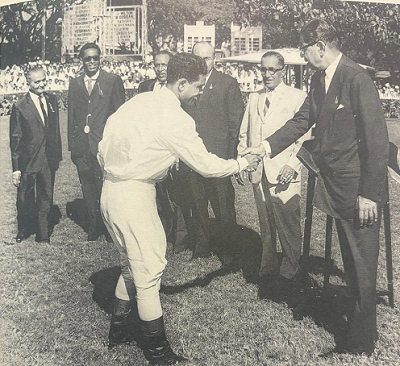
Jockey K. Raghunath being congratulated by Mr. R.R. Ruia
India hosted the Asian Racing Conference for the first time in 1966. It was inaugurated at Calcutta, there was racing at Hastings on Saturday and the delegates moved to Bombay on Sunday. The Bombay leg started with racing and that explains why the Derby was held on a Monday. The presence of the delegates from all the Asian racing countries made it the first Indian Derby which had a true international exposure. Even before the day's racing started, India had witnessed two momentous events. At 11.00 a.m., Shrimati Indira Gandhi had taken oath as India's third Prime Minister. Roughly around the same time, Air India's Boeing 707, named Kanchenjunga, had crashed accidentally in the Southern Alps, leaving no survivors. Among those who lost their lives was Dr. Homi Bhabha, the pioneer of India's nuclear programme.
1966 INDIAN DERBY
Bombay, Monday, 24 January 1966
A gold Trophy value Rs. 5,000; sweepstakes of Rs. 800 with Rs. 60,500 added from the Fund. Total stakes Rs. 1,09,500. Winner, the Trophy and Rs. 79,467.50; second, Rs. 22,705; third, Rs. 11,352.50; Rs. 5,975 to the Breeder of the winner.
For Indian Colts, Geldings and Fillies, four year-old only (foaled in 1962). Colts and Geldings 57 kgs., Fillies 55.5 kgs. 2400 m.
1. RED RUFUS (K Raghunath) (5/4, fav)
(ch c Dark William* - Red Belle by Redbay*)
M/s. Devchand K & D D Foman
2. Chief Ruler (S Smith) (15/1)
(b c Hyder Ali* - Model Queen by Linguaphone*)
Mrs. A L J Talib and M/s. Balchand Choraria & V K Chaubal
3. Bakhtawar (M J Rajoo) (9/2)
(b g Flower Dust* - Auroden by Worden II)
Mr. M D Mehta
4. Humour (G McGrath) (9/2)
(b c Premi* - Oh Ah* by Grand Weather)
M/s. Ramnath Daga, S R Daga & R Shivlal
Also ran: Monitor (B Duggan), March of Glory (J Roe), Royston Rock (M Jagdish), Noor Mahal (F Durr), Incognito (P Khade), Blazing Faith (P Shanker), Prathna (S Chavan), Jaidev (S Yeshwant), Lion Hearted (J Wilson), Silver Mist (N Brennan), Otello (A Robson), Bright Princess (Sadashiv) and Fish Pilot (N Shiba). 17 ran.
Winner trained by Meherjee
Verdict: 5 1/2, Shd, 3 1/2 Time: 2.38.8 (New Race Record)
Tote: Rs. 20 for win and Rs. 12, Rs. 35 and Rs. 15 for places.
First Indian Derby in which geldings participated.
Only Indian Derby run on a Monday.
Red Rufus is the earliest (16 Jan) born of all Indian Derby winners.
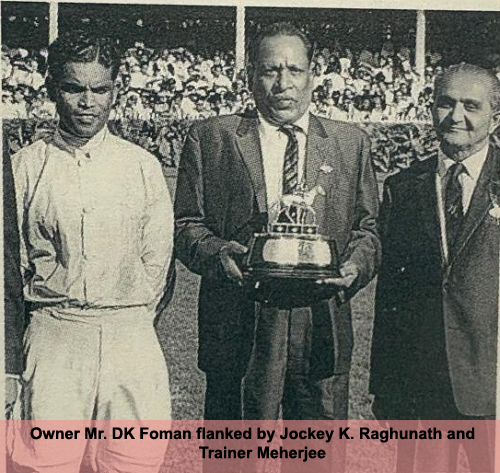
Red Rufus is a shining example of how racing treats everyone alike. It is called the Sport of Kings, but on the turf, a King and his subject are equal. Red Rufus was a horse who boasted, at best, a modest pedigree; he was owned by common fishermen and saddled by a trainer who averaged less than ten wins in a year; his jockey was a competent rider but nothing more. Despite all these limitations, Red Rufus proved himself to be a genuine, consistent galloper, a cut above his contemporaries and it was fitting that he should become the first horse to win the Indian Triple Crown and the Indian Turf Invitation Cup.
The Lead Up
Red Rufus was purchased in the ring for Rs. 35,000, the exact price that Talib had paid for Loyal Manzar four years earlier. Initially, the colt was owned by M/s. D K Foman and Pallon D Shroff but the partnership did not last long and the trainer took over Mr. Shroff 's share. Surprisingly for one with his pedigree, Red Rufus not only came to hand early but scored on his debut as a two year-old at Bombay, winning the Belfry Plate (1200 m.) by six lengths as a hot favourite under jockey Raghunath. Two weeks later, now running in a scurry with the winner's penalty, he was even more impressive at a much shorter price over Talib's Chief Ruler, Gwalior's Turkish Star and the 'got-abroad' No Falls. This time, Raghunath had Stan Smith, Frankie Durr and Joe Mercer finishing behind him.
For the Excelsior Stakes on the Republic Day Meherjee had two fancied runners; Deep Jyoti and Red Rufus, the latter giving 5 kgs. to the filly. Raghunath continued his association with Red Rufus while Wilson was astride Deep Jyoti who started as the favourite and prevailed by half a length over the stable companion. In mid-February came the Chief Minister's Gold Cup where Red Rufus found himself pitted against older horses in a handicap race. Meherjee's ward was set to carry 51.5, a weight Raghunath could not do. Hence, Shiba got the mount. As he was slowly off, Shiba let the colt find his stride. It was only when they had rounded the bend that Shiba asked Red Rufus for his run. The response was electrifying. Red Rufus left the field standing to win from the filly Jacqueline by three-parts of a length.
The juvenile racing at Bombay that season was dominated by Aziz Mahmoud who had the large Gaonkar string. The veteran Arab trainer saddled six individual winners. Meherjee, though, was not far behind with four. Surprisingly, Talib drew a complete blank. In less than 50 days, Red Rufus had run four races and won three of them. He deserved a rest and Meherjee gave him a long one. He next appeared after seven months in Poona. It was the combined Class III & IV 1200 m. Tricumdas Dwarkadas Cup and as he was again handicapped low, Shiba was given the ride. Once again Red Rufus started sluggishly. He improved steadily but was caught between Haven's Star and The Countess round the turn. Shiba managed to extricate him from the tight spot and set him after Monitor who had set sail for home. Red Rufus responded gallantly but was a neck shy of Monitor at the wire. Monitor was a smart sprinter and he won that race in a record time.
That was the only time Red Rufus ran in Pune. At the end of the season, Meherjee sold his share to Mr. D D Foman. For the rest of his career, the chestnut raced in the ownership of the father and son. Their colours were "all pink".
Red Rufus and Monitor faced each other again in the H H The Maharaja of Morvi Gold Cup after racing had returned to Mahalakshmi. Raghunath was back in the saddle and the odds of 7/4 made Red Rufus the favourite to exact his revenge. When Red Rufus headed Monitor at the distance, the favourite backers were in glee. Wilson on Monitor, though, fought back heroically to snatch a short-head verdict on the post and Raghunath's efforts to have the result reversed in the Stewards' Room came to a naught.
The revenge was delayed; not denied. In the Indian 2000 Guineas, the public sent Talib's Chief Ruler (Stan Smith) as the clear favourite at 7/4. Red Rufus, now 2.5 kgs. better off against Monitor, was next in demand at 4/1. Raghunath waited with Red Rufus in the race and bided his time till giving him the office. Past the First Enclosure, Red Rufus was in full flight and there was no catching him once he hit the front. Monitor hung on by a short-head from Bakhtawar with the favourite Chief Ruler making the frame a neck behind.
Red Rufus was the rage for the Ramniwas Ramnarain Ruia Gold Cup On the New Year's Day of 1966. He was backed down to even money. The Daga horse Humour (G McGrath), however, upset all calculations as he eked out a short-head victory over Bakhtawar (M J Rajoo), both the horses being easy to back at 8/1 in the ring. A length and a half behind came the favourite. He had been bumped around the 300 m. marker by Bakhtawar and lost his stride. If the backers of the favourite were in gloom, the Byramji camp was in glee. The young trainer had a four-timer that day through Golden Slipper (6/1), Humour (8/1), Tumsa Nahi Dekha (10/1) and Fair Flight (7/4) !
The Derby
With seventeen runners, it was a large field with three 'got-abroads', two fillies and Otello from Calcutta the only outstation challenger. The betting fraternity was aware of the interference Red Rufus had met in the Ruia and preferred to remember the way he had vanquished his rivals in the Indian 2000 Guineas earlier. The pedigree pundits reckoned that the colt was best suited by the extended mile and a half of the race. Raghunath's mount went to the post, confidently backed, at 5/4. Humour and Bakhtawar, who had finished ahead of him in the Ruia, were generally available at 9/2 or even 5/1 on some books.
When the field was despatched, Bakhtawar and the Bright Princess were slowly out. Red Rufus, who had Fish Pilot (N Shiba) as his pacemaker, was settled well in the midfield. Approaching the bend, Raghunath began to move up. He made steady progress round the curve and was fourth entering the straight. Once unleashed, Red Rufus put in a strong stretch run, put daylight between him and his rivals and won in a new race record time, stopping the clock 0.8 seconds faster than what Loyal Manzar had done six years earlier. It was a great day for the connections of Red Rufus. They had a double that day through Rainbow Trout.
Rest of the Career
Red Rufus was now at the peak of his prowess. He followed up with the Indian St. Leger in mid-January, taking charge of the race just before the bend and holding Bakhtawar by three parts of a length, clocking a new race record mark of 3.1, to seal his Triple Crown. On the first Sunday in March, he added the Indian Turf Invitation Cup to his kitty, putting it across Bakhtawar, yet again, Gurkirpal, the Calcutta challenger and the favourite for the race and the Byramji trained 1000-Oaks winning filly Radhapyari. That made him the first IndianTriple Crown and Invitation Cup winner. His winning time in the Indian Derby and Invitation Cup, on the same track and with the same weight carried, was exactly the same; 2.38.8.
The chestnut colt enjoyed the rains during the Pune season but deservedly was not asked to race. He was next seen under colours at Bombay, nine months after his Invitation Cup victory, in the Governor's Cup over a mile. Slated carry 47.5, it was Joseph who was given the leg-up. The long lay-off and, for him, the sharp distance meant that he was friendless in the market with his bracket-mate Rainbow Trout better supported. Starting at 10/1, he surprised one and all, beating two 'got-abroad' fillies --- the favourite Bright Princess and Gwalior's Lauretta -- and the old rival Humour convincingly. Three weeks later on Christmas Day, he was an even money fancy for the A C Ardeshir Trophy over the same distance. Raghunath was back in the saddle but it was not destined to be a fairy tale ending. He felt his legs during the race and could only manage to finish fourth behind Bakhtawar, Monitor and Chief Ruler. His innings was over and it was decided to send him to stud.
From 14 starts at 2 to 4, he won nine races (1000 m. to 2800 m.) and placed five times, earning Rs. 3,06,082. He never missed the board. He won the Indian Triple Crown, the Invitation Cup, R R Ruia Gold Cup, Governor's Cup, Chief Minister's Gold Cup and the H H Maharaja of Morvi Gold Cup. He was retired to stud and did not race at 5.
The Fomans
The Fomans were affluent fisher folk hailing from Koliwada in north Bombay, a suburb of Khar. They were well respected in the community and you will find Foman Nagar even today in Khar. They had owned a horse or two and even had a runner, Rainbow Trout, in the previous year's Derby. Their grey, Fish Pilot, had caused quite a stir when he beat the expensive, 'got-abroad' filly Bright Princess in 1965 at Mahalakshmi. (Fish Pilot was Red Rufus's pacemaker in the Derby). The Derby success did not go to their heads and they continued as before, racing on a modest scale. One notable filly that Mr. D K Foman bred was Maandavi. She later passed into the ownership of the Poonawallas and got the 1990 Indian Derby winner Desert Warrior. Maandavi came within a short-head of achieving history as only the second mare to produce two Indian Derby winners. Her daughter La Bonne Vie failed by a whisker to beat Astonish in the Derby two years later. To have owned Red Rufus and bred Maandavi is more than enough for a lifetime.
K Raghunath
Raghunath Kolse, whether as a jockey or a trainer, was always known as K Raghunath. He started as an apprentice with Maj. V M Lad who gave him his first ride towards the end of 1950 on a Gwalior horse called Pyare Sahib. It was a large field of 16 runners and Raghunath finished unplaced. Trainer Buckley also gave him a few mounts but his first winner was a long time in coming. It took almost five years and finally, he went first past the post in November 1955 on Baba Khan-trained Never Say Aye. The following year, he caught the eye riding for Baba Khan whenever Ahmed Khan could not do the weight and booted home 15 winners. When Baba Khan went back to Madras, Raghunath went with him and had a couple of fair seasons, also riding for Bal Lagad who was training for Mr. M P Davis.
He returned to Bombay and had his best year ever in 1963-64 to bag the Mahalakshmi Jockeys' Championship. By now, he was facing weight problems and losing out on winning rides. In the year of Red Rufus, he rode 18 winners but some of his mounts went to S Yeshwant who won the Championship with 23 wins. Raghunath was also the Champion at Poona in 1960-61. Towards the end of the 1960s he decided to pack his saddle. Over two decades, he rode a little over 200 winners. Apart from his four Classic wins on Red Rufus, he also won the Bangalore Colts' Trial on Mohsin The Second for Baba Khan and the South India 2000 Guineas atop Mica Emperor for Khan Baba. The numbers are not very flattering but he is the only jockey to have ridden an Indian Triple Crown winner and the Invitation Cup winner in all his four victories. The Invitation Cup win must have enabled Raghunath to put some of his demons to rest. Surely, losing a stirrup on Prince Pradeep just after the start of the 1964 Invitation Cup at Calcutta and finishing second would have caused some nightmares. At his best, Raghunath was an uncomplicated jockey who packed a powerful punch.
After about twenty years as a jockey, Raghunath had a little over two decades as trainer with only a brief gap between his two careers. He started his second innings with a bang, his first two runners both winning in Mr. N N Sippy's colours at Bombay on 21 November 1970. He led in about 350 winners during his career as trainer including Furioso with whom he won the Indian 2000 Guineas for Mr. A J Fernandes. He was the Champion Trainer at Mahalakshmi in 1979-80 and 1981-82. He saddled a few runners during the Poona season of 1991 and then gave up his license. A Champion Jockey and a Champion Trainer at Mahalakshmi; that's a distinction only two other individuals -- Kheem Singh and Pesi Shroff -- have.
He had kidney problems in his later years to which he finally succumbed. His sons Nana Raghunath and Sanjay Kolse followed in his footsteps to become trainers. Unfortunately, Nana Raghunath passed away much too young.
Meherjee
Meherjee is unique. He had a career on the turf, both as a jockey and a trainer for about 55 years and the records have him as only Meherjee; no first name, no last name, no initials ! As a jockey, he first figures in March 1919, riding Mr. G E D Langley's Rare Find at Bombay. His first win came a year later at Lucknow on Mr. Kashi Charan's Varlet. He could do 6-6 then [approx. 41kg] ! He rode mostly at lesser centres and his final win was on Mr. R S Irani's Cougar at Kolhapur in 1940. After that, he did not have a winner for over three years and after riding one final time in 1943 at Mahalakshmi, he hung up his boots.
He started training that Poona season and was off the mark when Mr. Dhunjishaw Cursetji's Manak won in September. He was soon embroiled in controversies. In March 1945 his horse Black Hunter was found to be doped and he lost his license. He came back after cooling his heels for three years when the City Gates case happened and again his license was suspended. Reinstated in the early 1950s, he somehow managed to survive, sending out just 47 winners in 12 years. In the mid-1960s, he hit, what by his previous record, was a purple patch. In 1963-64, he had his first year in double figures and the next two years, when Red Rufus was in his yard, were his best. After that, he regressed. In April 1975 he sent out his last winner, Mr. F S Reporter and Miss D B Desai's Nylobolt.
His career tally of wins came to just about 230. Yet, he handled Red Rufus faultlessly and around that time showed that he was quite capable, saddling horses like Deep Jyoti, Rainbow Trout, Kecini, Alcmene, Cambyses and Sherdil.
PAST THE POST
Meherjee's son Mackie also became a trainer before the decade ended and both, father and son, were leading in winners in the same season. They trained only one Classic winner each in their respective careers. Meherjee saddled Red Rufus; Mackie Meherjee led in Red Rufus's first Classic winner, the filly Red Surprise ! Mackie Meherjee later had long stints as a Handicapper with MRC and RWITC.
News Letter
Contact
Email: info@indiarace.com

- HOME
- STUD FARMS
- ARCHIVES
- GLOSSARY
- CLASSIFIEDS
- EX-NAME SEARCH
- DAM
- SIRE
- ROLL OF HONOURS
- FEEDBACK
- HORSE TALK


